Travel should be a grand escape — an escape from busy work, an escape from the limits that bind us. And escape itself should not become a burden.
By Yuhan Yang
In January this year, I planned a long-awaited trip to South Korea.
Although the trip would last for nine days starting from late January, I began planning it one month in advance.
I spent a lot of time browsing social media platforms such as Xiaohongshu and Instagram, watching carefully designed travel plans made by different bloggers, such as “The perfect 3-day Seoul itinerary” and “The best 7-day Korea travel route.”
There was a huge amount of information, very detailed and complex. And all of it seemed to tell you that these routes were perfect, and these places were worth or not worth visiting.
So, based on all this information, I made a very detailed travel plan. I even planned what I should do at specific times, which places to visit, and how long transportation would take.
Everything I did was to make sure that I could have a perfect, well-organized, and anxiety-free trip.
However, after one of my friends, who is more spontaneous, looked at my plan, she said with a complicated and slightly worried expression:
“Why does it feel like you’re going on a business trip instead of traveling?”
I was stunned.
Yes… when was the last time you, and I, had a truly free and spontaneous trip?
Social media has strengthened travel anxiety
Thinking more deeply, the arrival of the algorithm age has made many parts of our lives more convenient. However, visual-based social media platforms like Xiaohongshu, Instagram, and TikTok have quietly shaped how we think about travel.
In the past, when social media was not so popular, travel information was usually shared through word of mouth, which directly inspired people to travel.
But now, when we face algorithm-recommended travel guides and carefully edited photos, we begin to think too much before traveling:
- We worry that “real life may not look as good as the photos”.
- We feel anxious that “our travel photos may not look good enough”.
- We feel confused because “there is too much information, and we don’t know how to choose or plan our trip”.
Social media does not directly tell us what to do.
But the For You Page makes us feel that we should have the same kind of “perfect” trip.
Why do we feel anxious?
This is because the unique social media environment creates a kind of travel anxiety which is triggered by social media itself. Unlike other media – such as travel guides or direct recommendations from friends – Instagram and Xiaohongshu can amplify our anxiety by exposing us to unrealistic ideal travel scenarios, as travelers may feel their trips aren’t “Instagram-worthy” enough.
This anxiety is often related to factors such as social comparison and the gap between expectations and reality.
- Social comparison
According to social comparison theory, individuals have an inherent tendency to compare themselves with others to assess their own abilities and life outcomes. In the context of tourism, users can access scenarios of upper-class society or ideal travel through social media platforms. Specifically, travel bloggers and influencers often showcase luxury destinations and flawless travel experiences, creating unrealistic standards for ordinary travelers and imposing pressure on them to “produce great photos”.
The exposure of this idealized content exacerbates the anxiety of ordinary users, who worry that their plans or trips cannot meet these standards, and whether their travels are exciting enough or visually appealing enough to be shared online, thus creating a sense of significant gap between their own abilities and those of others.
- Expectation gap
Because content shared on social media platforms like Instagram and Xiaohongshu is often highly filtered and idealized, people tend to have excessively high expectations of travel destinations and experiences.
Furthermore, many travel photos accessed by social media users are heavily edited or filtered, exaggerating the beauty or allure of destinations and creating false expectations. When the actual destination falls short of the online descriptions, a cognitive dissonance arises between expectations and reality, exacerbating potential disappointment.
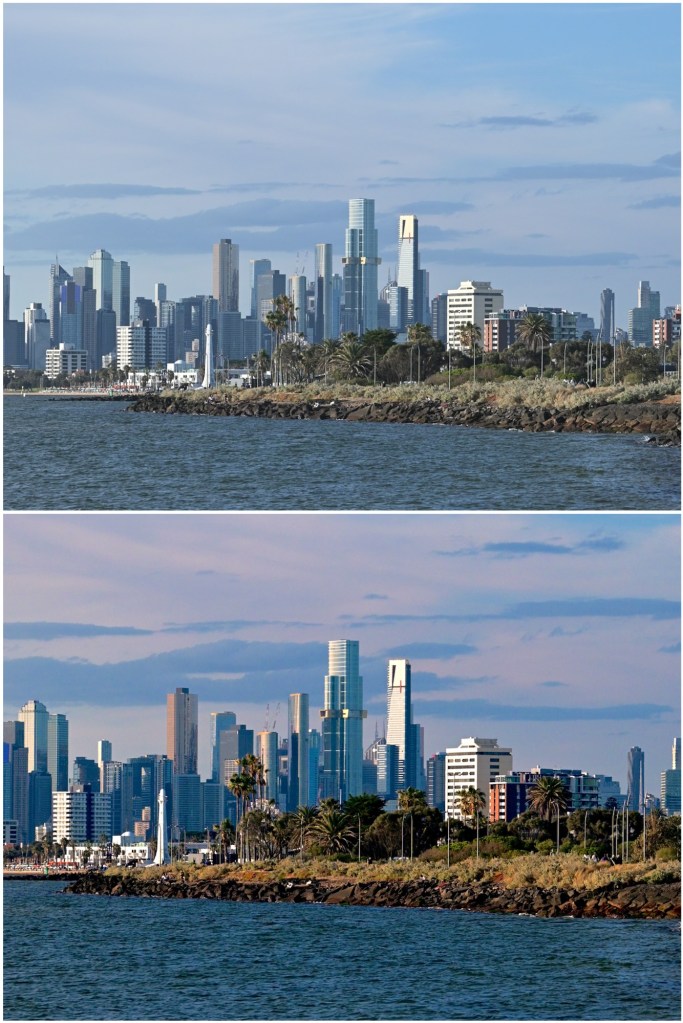
Therefore, faced with a large amount of potentially misleading content, users may doubt its authenticity, reinforcing pre-trip uncertainty and anxiety.
What are we traveling for?
In the movie The Legend of 1900, the main character, 1900, chooses to stay on the ship because he is afraid of the outside world.
Isn’t social media like that ship that traps us?
Everything about the outside world is shaped and reconstructed by algorithms on social media, making it hard for us to tell what is real. What remains is only anxiety and fear.
But travel should be a grand escape —
an escape from busy work,
an escape from the limits that bind us.
And escape itself should not become a burden.
So, even if it is not perfect,
please allow yourself to go on a free, and spontaneous journey.
 Realo
Realo 